By Dr.Shahzad khurram , Verified medical authority
Medical review notes: eggs are a recommended addition at this age, meat-based purées are not required, and processed or “junk” snack foods should be avoided.
In almost every 8-month checkup, parents ask a version of the same question because they feel concerned: “Is my baby eating enough? Too much? The right things?” On that account, the information follows the same format used in a medical office, where each question is addressed individually.
8-Month-Old Baby Feeding needs How much solid food ?
Parent: “She’s on three meals now, but I feel like she barely eats anything. Should I be worried?”
Pediatrician: Not at all. At 8 months, most babies are moving toward 2–3 small meals a day, plus 1–2 snacks once they’re comfortable with finger foods. But here’s the part that catches parents off guard: breast milk or formula is still doing the heavy lifting nutritionally. Solids at this stage are about practice — learning to chew, swallow, and enjoy new flavors — not about hitting a calorie target.
Rough daily feeding guide (8 months)
| Feeding Type | Approximate Amount | Frequency |
|---|---|---|
| Breast milk or formula | 24–32 oz total | 4–5 feeds/day |
| Solid meals | 2–4 tbsp per food, building up | 2–3 meals/day |
| Water (from a cup) | Small sips, up to 2–4 oz | With meals |
| Finger food snacks | A few pieces at a time | 0–2 snacks/day |
These numbers are a starting point, not a scoreboard. Babies self-regulate remarkably well when we let them.

Micronutrients Matter More Than Calories Right Now
This is the advice I wish more parents received earlier: at 8 months, solid foods mainly help build iron stores and introduce new textures and flavors, not to replace milk feeds. Breastfed babies, in particular, start running low on their natural iron reserves from birth around this age. This is why iron-rich first foods are so important.
Best iron-rich foods for infants at this stage include:
- Iron-fortified infant cereals
- Well-cooked, mashed lentils and beans
- Pureed or finely scrambled egg (yolk and white — more on why below)
- Iron-fortified formula, if not breastfeeding
if you’re not breastfeeding I often get asked whether meat needs to be included to meet iron needs. It doesn’t have to be. Many families do well with plant-based and egg-based iron sources, especially when paired with a vitamin C-containing food (like a bit of mashed fruit) to improve absorption.
The “Why” Behind Texture Progression (and Why It’s Not as Scary as It Feels)
Parent: “I’m terrified of choking. How do I know she’s ready for lumpier food or finger foods?”
Pediatrician: This fear is so common, and it makes total sense — but understanding what’s happening in your baby’s mouth usually helps a lot.
Newborns feed with a simple suck-swallow pattern. Somewhere around 6–9 months, babies develop lateral tongue movements — the tongue starts moving side to side, pushing food toward the back teeth (even before those teeth exist) instead of just straight back. This is the physical skill that lets a baby move from smooth purees to mashed or lumpy textures, and eventually to soft finger foods.
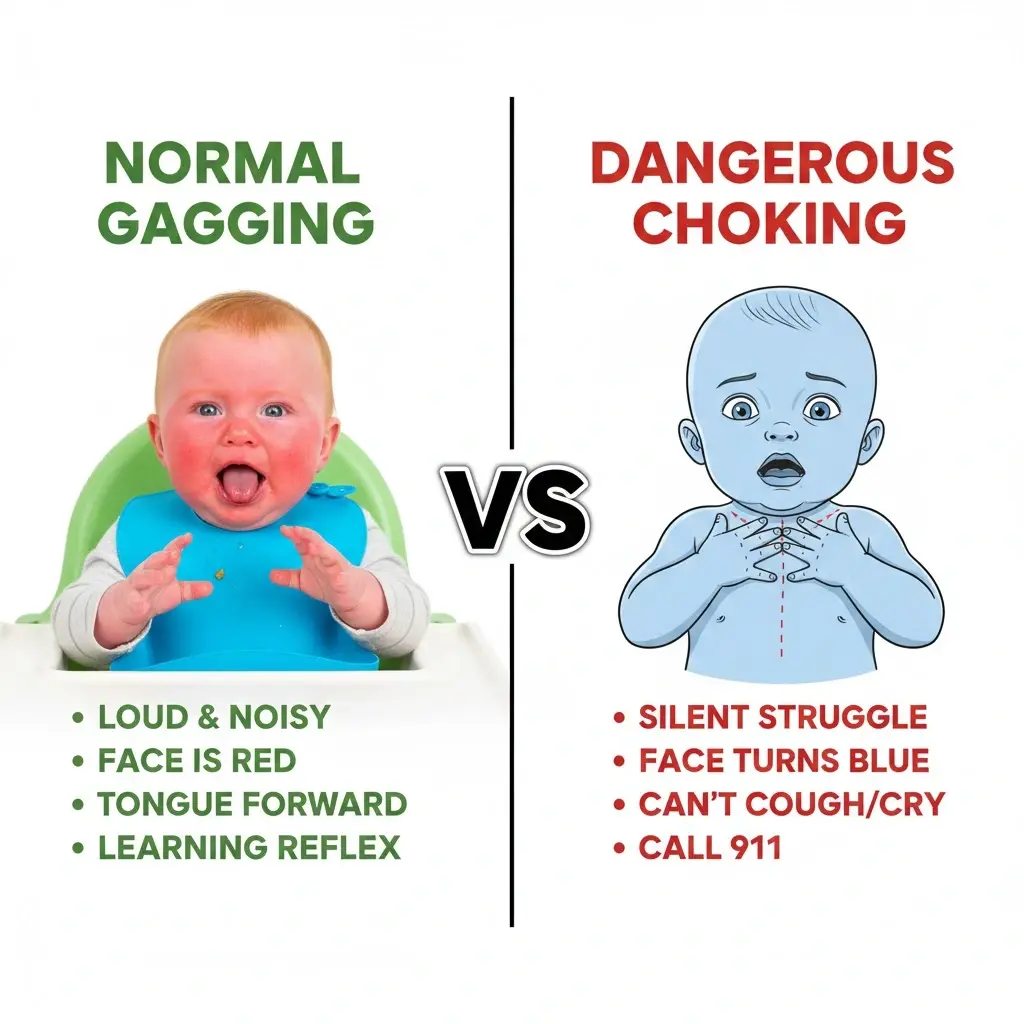
Signs of gagging vs. choking in babies — this distinction is worth memorizing:
- Gagging is loud, active, and often looks dramatic: coughing, retching, pushing the tongue forward, maybe a red face. It’s the airway protecting itself, and it’s normal and healthy.
- Choking is quiet. Look for a silent baby, weak or no cough, and bluish lips or skin. This needs immediate action.
Signs your baby is ready for finger foods:
- Sits steadily without support
- Has largely lost the tongue-thrust reflex (doesn’t automatically push all solids back out)
- Can bring food to their mouth and starts using a pincer grasp (thumb and forefinger)
Soft, easy-to-mash pieces — ripe avocado, steamed carrot sticks, banana — are ideal starting finger foods.
Introducing Allergens Safely — Including Egg
Parent: “Everyone told me to wait on eggs and peanuts until my baby was older. Is that still the advice?”
Pediatrician: That advice has changed, and it’s one of the most important updates I share with families. Current pediatric guidance, following major trials on allergy prevention, now supports introducing common allergens — including egg and peanut — early, around 6 months, rather than delaying them. Delaying no longer appears protective; if anything, the evidence points the other way.
How to introduce allergens safely to an 8-month-old:
- Introduce one new allergen at a time.
- Offer it in the morning or early in the day, so you can watch for a reaction.
- Start with a small amount (for example, a spoonful of well-cooked, mashed egg).
- Keep offering it regularly once tolerated — regular exposure appears to matter, not just a single try.
- If your baby has significant eczema or a known food allergy, talk with your pediatrician before starting, since some higher-risk babies benefit from a more supervised introduction.
How do I know if it’s an allergic reaction, not just a “baby rash”? Ordinary drool rash or a mild reaction to acidic food (like tomato) tends to stay around the mouth and chin, and fades within an hour or so. True allergic reactions can include:
- Hives (raised, itchy welts) beyond the mouth area
- Swelling of the lips, face, or eyes
- Vomiting shortly after eating
- In serious cases: difficulty breathing, wheezing, or lethargy — this is an emergency
If you see anything beyond a mild, localized rash, call your pediatrician. If there’s swelling of the mouth/throat or breathing trouble, rush to an emergency room.
Reading Your Baby’s Cues: Full vs. Just Not Interested
Babies are surprisingly good at telling us what they need — if we’re watching for it.
Signs of fullness/satiety:
- Turning the head away from the spoon
- Closing the mouth or pushing the spoon away
- Slowing down, getting distracted, playing with food instead of eating it
Signs of disinterest that aren’t about hunger:
- Overtired or overstimulated at mealtime
- Teething discomfort
- Simply having an “off” day (this happens to all of us)
If your 8-month-old is not interested in food at a given meal, it’s almost never an emergency. Offer the food again without pressure, keep meals relaxed, and trust that appetite naturally has ups and downs. Forcing “one more bite” can actually make babies more resistant to trying new foods over time.
Can My 8-Month-Old Have Water?
Yes — small sips, roughly up to 4–8 ounces a day, offered in an open cup or straw cup with meals, are fine. Just don’t let water replace breast milk or formula, which are still your baby’s main source of nutrition and hydration at this age.
What About Switching Formulas?
Fussiness or gas can tempt parents toward specialty formulas — hydrolyzed or “sensitive” options — without a clear medical reason. A 2025 retrospective cohort study looked closely at this question. The researchers found that non-standard, hydrolyzed, cow-milk-based infant formulas were linked to different early childhood growth outcomes compared with standard formulas and breastfeeding (Rani et al., 2025). In plain terms: switching formulas isn’t a neutral decision — it can influence a baby’s growth trajectory over time. If your baby seems fussy, it’s worth a conversation with your pediatrician before changing formulas on your own.
Night Feeds: Still Normal at 8 Months
Parent: “Is it okay that she’s still waking up to eat at night?”
Pediatrician: For many babies, yes. Night waking at 8 months can mean real hunger, especially during a growth spurt or with more activity during the day. It can also be due to a sleep association. Your baby may have learned that waking leads to a comforting feed, regardless of whether they are hungry. Both situations are normal and do not indicate you are doing anything wrong. If it is exhausting your family, we can discuss gentle methods to gradually change that pattern. However, there is no rush, and it’s not something that needs to be fixed right away
A Note on What to Skip
Two things worth avoiding at this age: meat-based purées aren’t necessary — plant and egg sources can comfortably cover iron and protein needs — and processed snack foods, sugary items, and salty packaged snacks have no place in an 8-month-old’s diet. Their kidneys and taste preferences are still developing. Early exposure to heavily processed food can influence future eating habits.
The Bottom Line
Feeding an 8-month-old is less about precision and more about steady, relaxed exposure: let milk feeds keep doing the nutritional heavy lifting, use solids to build iron stores and new skills, introduce egg and other allergens early rather than later, and watch your baby’s cues more than the clock. If something feels off — a reaction, a sudden refusal to eat, worry about weight gain — that’s always worth a call to your pediatrician. That’s what we’re here for.
This article is for general information and does not replace individualized medical advice. Please discuss your baby’s specific feeding plan with your pediatrician, especially if there is a family history of food allergies or eczema.
Frequently Asked Questions
How much solid food should my 8-month-old eat per day?
At 8 months, most babies transition to 2–3 small meals a day and 1–2 snacks. However, breast milk or formula remains their primary source of nutrition. Solid foods at this stage are for practicing chewing, swallowing, and exploring new textures rather than hitting a specific calorie target.
What are the best iron-rich foods for an 8-month-old?
Excellent options include iron-fortified infant cereals, well-cooked mashed lentils and beans, and finely scrambled or pureed eggs (both yolk and white). Meat-based purées are not strictly necessary to meet daily iron goals if these plant and egg sources are provided regularly.
How do I tell the difference between gagging and choking?
Gagging is loud, active, and a normal protective reflex that involves coughing, retching, and pushing the tongue forward. Choking is quiet and dangerous; the baby will be silent, unable to cough effectively, and their lips or skin may turn bluish. Choking requires immediate emergency intervention.
When and how should I introduce common food allergens like eggs?
Current pediatric guidance recommends introducing allergens early (around 6 months). Introduce one allergen at a time in the morning to monitor for reactions. Start with a small amount, like a spoonful of mashed egg, and maintain regular exposure if it is well-tolerated.
Can my 8-month-old baby have water?
Yes. You can offer small sips of water (up to 4–8 ounces a day) in an open or straw cup during meals. Water should only supplement their diet and never replace breast milk or formula.
Is it normal for my baby to still wake up for night feeds?
Yes, completely normal. Night waking at 8 months can be driven by a daytime growth spurt, increased physical activity, or a learned comfort association with feeding.
What foods should be avoided at 8 months?
Skip highly processed foods, sugary treats, and salty packaged snacks. Their kidneys are still maturing, and early exposure to heavily processed items can negatively influence their future taste preferences.
References
- Snetselaar, L. G., de Jesus, J. M., DeSilva, D. M., & Stoody, E. E. (2021). Dietary Guidelines for Americans, 2020–2025. Nutrition Today, 56(6), 287–295. https://doi.org/10.1097/nt.0000000000000512
- Rani, U., Alwasila, R., Story, W. T., Ten Eyck, P., Hoberg, A., Santillan, D. A., & Imdad, A. (2025). Effects of infant formula type on early childhood growth outcomes: A retrospective cohort study. Nutrients, 17(19), 3111. https://doi.org/10.3390/nu17193111
- American Academy of Pediatrics (AAP) — guidance on early allergen introduction
- U.S. Food and Drug Administration (FDA) — health claim notification on allergenic food introduction
Dr. Shahzad Khurram is a dedicated Pediatrician and medical researcher passionate about empowering parents with evidence-based health insights. With a clinical focus on childhood nutrition and neurodevelopment, Dr. Khurram translates latest clinical data into actionable advice for modern families. Through Medifitverse, he bridges the gap between pediatric science and everyday parenting, ensuring every child has the nutritional foundation they need to thrive. His work is guided by the latest standards from the American Academy of Pediatrics and current nutritional research.
Medical Disclaimer: The information on Medifitverse, including text, graphics, and images, is for educational and informational purposes only. This content is not intended to be a substitute for professional medical advice, diagnosis, or treatment. Always seek the advice of your pediatrician or other qualified health provider with any questions you may have regarding a medical condition. Never disregard professional medical advice or delay in seeking it because of something you have read on this website.However, every baby is different. Consult your doctor before introducing allergens or changing your infant’s diet.
Contact Dr. Shahzad Khurram here, or click whatsapp icon for direct chat.
Pingback: The 7-Month-Old Feeding Schedule: A Pediatrician’s Guide To Solids