
By Dr.Shahzad khurram , Verified medical authority
If you’ve searched “free autism test” at 11 p.m. because something in your gut told you to check on your child, you’re not alone. Thousands of parents do this every day. But before you let a five-minute online quiz decide how you feel for autism, let’s talk about what these tools can and can’t do.
As a medical professional, it is critical to distinguish between validated screening tools / free autism test and online quizes which are often non-clinical and can lead to significant psychological distress, misdiagnosis, or a false sense of security. This article walks through the difference, and more importantly what to do next.
Clinical Autism Screening vs. Online Quizzes: Truth of Free Autism Test
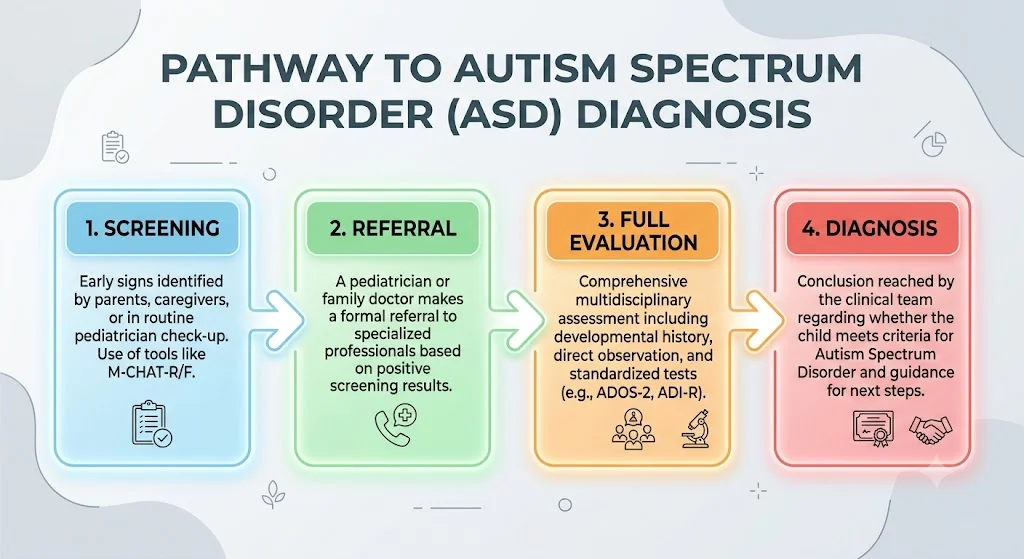
Most “free autism test” pages blur one important line: the difference between a screening tool and a diagnostic evaluation.
What a screening tool actually does
A screening questionnaire, like the M-CHAT-R/F (Modified Checklist for Autism in Toddlers, Revised), is a short, research-backed set of questions used to flag children who may be at higher risk. Pediatricians use it during routine OPD visits as a free autism test tool. It’s a good tool, but it was never designed to diagnose anything on its own.
What a diagnosis actually requires
A diagnosis comes only from a full evaluation, usually involving:
- A developmental pediatrician, child psychologist, or multidisciplinary team
- Direct observation of the child’s play and communication
- Structured, professionally administered tools such as the ADOS-2 (Autism Diagnostic Observation Schedule) or the ADI-R (Autism Diagnostic Interview–Revised)
- A review of developmental history from parents, teachers, and caregivers
No online quizes /free autism test replicates this process, no matter how detailed its questions look.
The False Positive/False Negative Problem of a Free Autism Test
Every screening tool (free autism test) has a sensitivity and specificity rate, meaning, how well it find real cases versus how often it’s wrong. Validated tools like the M-CHAT have been studied for this. Free online quizzes almost never have and are not diagnostic gold standards, and getting the wrong signal cuts both ways:
- False positives cause unnecessary panic, sleepless nights, and sometimes rushed decisions.
- False negatives give families false reassurance and can delay a child from getting support they actually need.
Neither outcome is harmless. This is one of the strongest reasons to treat a free autism test result as a prompt to talk to a doctor not as an answer.
Autism Rarely Shows Up Alone: The Comorbid Conditions Scenario
Many online tools (free autism test) treat autism as an isolated checklist item. In real clinical practice, social-communication differences frequently overlap with:
- ADHD
- Anxiety disorders
- Speech and language delays
- Sensory processing differences
A short quiz / free autism test can’t tell these apart, and it definitely can’t tell you if more than one is present at once. Only a trained evaluator, looking at the whole child, can sort that out.
Not Every Tool Was Built for Every Family
Cultural and linguistic validity matters. Many popular online screening tools (free autism test) were developed and tested on narrow populations — often English-speaking families from similar cultural backgrounds. If a tool hasn’t been validated for your child’s language, culture, or family structure, the result may simply not be accurate for them. Bilingual and multicultural households, in particular, deserve an evaluator who understands typical variation in that context — not a generic scoring script.

Signs of Autism by Age Group
Toddlers (under 3 years of age)
- Limited eye contact
- Not responding consistently to their name
- Not pointing to show interest
- Delayed or absent speech milestones
- Repetitive movements or intense focus on specific objects
School-age children
- Difficulty with back-and-forth conversation
- Trouble reading social cues among peers
- Strong preference for routines
- Intense, narrow interests
Adults
Adult presentations often look different — masking social difficulty, high anxiety in social settings, or a lifelong pattern of feeling “out of step” with peers that was never formally evaluated in childhood.
Validated Autism Screening Tools for Parents
If you want a starting point that’s actually evidence-based, ask your pediatrician about these:
- M-CHAT-R/F — for toddlers, administered in-office
- SCQ (Social Communication Questionnaire) — often used for school-age children
- AQ (Autism Spectrum Quotient) — sometimes used as a starting point in adult evaluations, though it is not diagnostic
Developmental Pediatrician Referral Process: What Happens Next
- Talk to your pediatrician first. Bring specific examples, not just a general feeling.
- Complete a validated screening tool in-office, if it hasn’t been done recently.
- Get a referral to a developmental pediatrician, child psychologist, or early intervention program if the screen suggests risk.
- Prepare for the evaluation visit:
- Bring specific behavior examples and, if possible, short videos
- Bring any prior screening results or pediatrician notes
- Note family history of autism, ADHD, or related conditions
- Understand evaluations differ by age — toddler evaluations lean on play-based observation; school-age evaluations add teacher and peer-interaction input; adult evaluations rely more on life history and self-report.

When to Seek a Formal ASD Evaluation
Request a referral if you notice persistent, multiple signs symptoms across settings (home, school, daycare) , not just a single behavior on one day. Trust your observations as a parent; you spend more time with your child than any quiz author ever will.
A Word on Medication and Supplements for Autism
Parents often ask about treatment options once autism is on their radar. Here’s the clear clinical picture:
- There is currently no FDA-approved medication that treats autism itself.
- Risperidone and aripiprazole are FDA-approved, but only to manage irritability associated with autism spectrum disorder — not autism itself. These require an in-person psychiatric evaluation and ongoing monitoring, due to risks including metabolic changes, movement disorders, and sedation. They should never be started based on an online recommendation.
- Regarding supplements: a Cochrane systematic review examined combined vitamin B6-magnesium treatment and found the evidence insufficient to recommend it for autism. Over-supplementing vitamin B6 can cause peripheral neuropathy (nerve damage) — more is not safer.

Frequently Asked Questions
Can an online quiz officially diagnose my child with autism?
No. Only a qualified clinical team using structured, validated tools and direct observation can make a diagnosis.
What are the gold-standard diagnostic tools for autism?
The ADOS-2 and ADI-R are widely regarded as gold-standard instruments, but both must be administered by trained professionals.
What should I bring to my first appointment with a developmental specialist?
Specific behavior examples, videos if available, prior screening results, and family developmental history.
How does autism screening differ for toddlers versus school-age children?
Toddler screening relies heavily on play-based observation; school-age screening incorporates classroom performance and peer social interaction.
Are there specific screenings for autism in adults?
Yes, though adult evaluation tools focus more on life history, self-report, and masking patterns than toddler-focused checklists.
Conclusion
An online free autism test can be a reasonable nudge to seek professional advice but it should never be the final word. If a quiz result has you worried, that worry is valid; what matters next is where you take it. Start with your pediatrician, ask about a validated screening tool, and let a trained team guide the path from there.
As a pediatrician i have made a autism screening tool on my website health tool page, visit it and have a real score about screening your kid. (free autism test)
Addressing the gap between initial signs of autism, referral for evaluation, and early diagnosis is critical for both short and long term outcomes of families and children and heavily relies on adequate assessment approaches. While recent events have revealed that families may benefit from telehealth options, further research is needed to examine the reliability and validity of remote assessment instruments. The acceptability, feasibility, and accessibility of such approaches also require further examination. Finally, the development of culturally and linguistically informed assessments is a critical avenue for future work with implications for both research and practice. Involving stakeholders in this work (e.g., caregivers, autistic adults, providers), especially those who work with or are from marginalized communities, is imperative
References
- Lord, C., Brugha, T. S., Charman, T., et al. (2020). Autism spectrum disorder. Nature Reviews Disease Primers, 6(1), 5. https://doi.org/10.1038/s41572-019-0138-4
- Nye, C., & Brice, A. (2002). Combined vitamin B6-magnesium treatment in autism spectrum disorder. Cochrane Database of Systematic Reviews, (4). https://doi.org/10.1002/14651858.cd003497
- Yu, Y., Ozonoff, S., & Miller, M. (2023). Assessment of Autism Spectrum Disorder. Assessment, 31(1), 24–41. https://doi.org/10.1177/10731911231173089
- CDC: Autism Spectrum Disorder — Screening and Diagnosis
- AAP: Developmental Screening Guidelines
Dr. Shahzad Khurram is a dedicated Pediatrician and medical researcher passionate about empowering parents with evidence-based health insights. With a clinical focus on childhood nutrition and neurodevelopment, Dr. Khurram translates latest clinical data into actionable advice for modern families. Through Medifitverse, he bridges the gap between pediatric science and everyday parenting, ensuring every child has the nutritional foundation they need to thrive. His work is guided by the latest standards from the American Academy of Pediatrics and current nutritional research.
Medical Disclaimer: The information on Medifitverse, including text, graphics, and images, is for educational and informational purposes only. This content is not intended to be a substitute for professional medical advice, diagnosis, or treatment. Always seek the advice of your pediatrician or other qualified health provider with any questions you may have regarding a medical condition. Never disregard professional medical advice or delay in seeking it because of something you have read on this website.However, every baby is different. Consult your doctor before introducing allergens or changing your infant’s diet.
NOTE: Check my folic acid for kids blog which helps autistic kids.
Contact Dr. Shahzad Khurram here, or click whatsapp icon for direct chat.
Pingback: Folic Acid For Kids: 2026 Pediatrician's Guide To Dosage.