By Dr.Shahzad khurram , Verified medical authority
Quick Answer
Measles is a highly contagious viral illness that starts with fever, cough, a runny nose, and red, watery eyes, followed a few days later by a rash that spreads from the face down the body. There’s no specific antiviral treatment, care focuses on rest, fluids, and managing symptoms, but the MMR vaccine is highly effective at preventing infection in the first place. If you think you or your child has been exposed, call a healthcare provider before showing up in person, since measles spreads through the air even before the rash appears.
What Is Measles?
Measles (also called rubeola) is a respiratory viral infection caused by the measles virus, a member of the paramyxovirus family. It’s one of the most contagious diseases known. Roughly 90% of unvaccinated people who are exposed will go on to develop the infection. Before routine vaccination, measles was a near universal childhood illness; the U.S. declared it eliminated in 2000, meaning there was no continuous domestic spread for over a year. That status is now under strain: As of August 6, 2026, 2,465 confirmed measles cases were reported in the United States in 2026. Among these, 2,449 measles cases were reported by 47 jurisdictions: Alabama, Alaska, Arizona, California, Colorado, Connecticut, Delaware, District of Columbia, Florida, Georgia, Idaho, Illinois, Indiana, Iowa, Kansas, Kentucky, Louisiana, Maine, Maryland, Massachusetts, Michigan, Minnesota, Missouri, Montana, Nebraska, New Jersey, New Mexico, New York City, New York State, North Carolina, North Dakota, Ohio, Oklahoma, Oregon, Pennsylvania, Rhode Island, South Carolina, South Dakota, Tennessee, Texas, Utah, Vermont, Virginia, Washington, West Virginia, Wisconsin, and Wyoming. A total of 16 measles cases were reported among international visitors to the United States.
The reason measles keeps resurfacing isn’t that the virus changed, it’s that vaccination coverage has slipped in some communities, and it takes very little space for an extremely contagious virus to find unprotected people.
What Causes Measles and How Does It Spread?
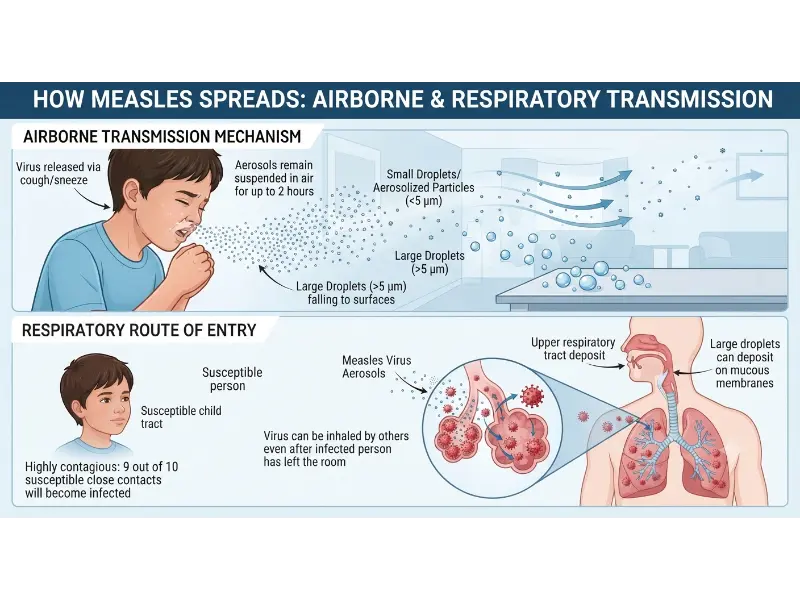
Measles spreads through respiratory droplets and airborne particles released when an infected person coughs, sneezes, or even just breathes and talks. The virus can linger in the air of a room for up to about two hours after the contagious person has left which is why “shared airspace,” not just direct contact, counts as an exposure. It can also spread by touching a contaminated surface and then touching your eyes, nose, or mouth, though airborne spread is the dominant route.
This is a key reason measles is so much harder to contain than many respiratory illnesses: a person can be contagious for days before anyone even suspects measles, since the first symptoms look like an ordinary cold.
How Contagious Is Measles?
Extremely. A single person with measles can infect a large share of susceptible people they share space with one of the reasons a small handful of introduced cases can turn into a real outbreak in a community with pockets of unvaccinated people. People are considered contagious from four days before the rash appears until four days after it appears, meaning someone can spread the virus well before they or anyone around them realizes they’re sick.
Measles Incubation Period
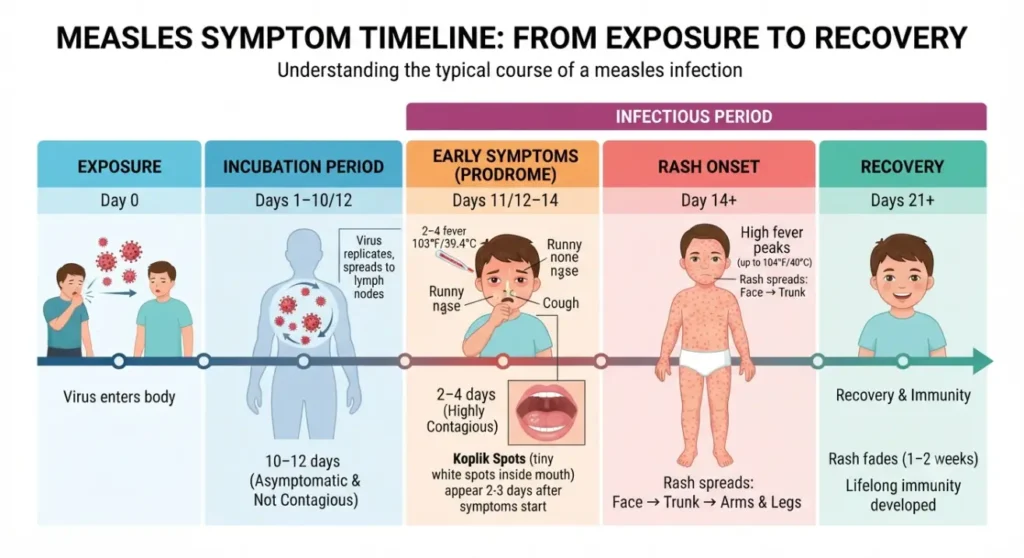
Symptoms typically begin 7 to 14 days after exposure to the virus, though the full range can occasionally extend a bit longer. That gap between exposure and first symptoms is what makes contact tracing during outbreaks so labor intensive: health departments often ask exposed, unprotected individuals to monitor for symptoms or quarantine for around three weeks from exposure, since it can take that long for illness to show up.
Early Signs of Measles
Before the rash, measles usually announces itself with what clinicians call the “three C’s” plus fever:
- Fever, which can climb quite as high as 105°F as the illness progresses
- Cough
- Coryza (a runny or congested nose)
- Conjunctivitis (red, watery, light-sensitive eyes)
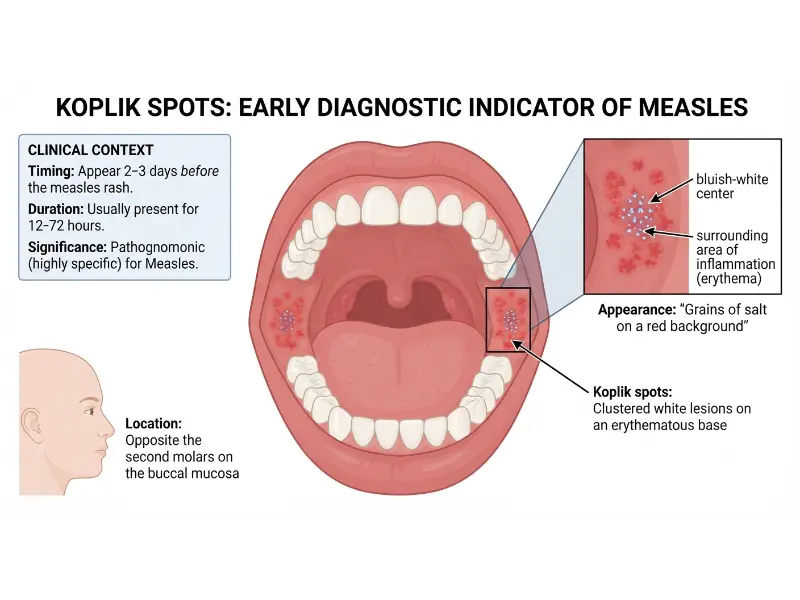
At this stage, measles is easy to mistake for a bad cold or flu. Two to three days into this phase, small white or bluish-white spots — Koplik spots — may appear on the inside of the cheeks. They’re not always looked for outside a clinical exam, but when present, they’re a strong early clue that this is measles rather than a routine virus.
Full Symptom List
Beyond the early signs above, as the illness progresses people with measles may experience:
- High fever, sometimes spiking again as the rash appears
- Sore throat
- Fatigue and body aches
- Loss of appetite
- The characteristic rash (detailed below)
- In children specifically, ear infections in roughly 1 in 10 cases and diarrhea in fewer than 1 in 10 cases
What Does the Measles Rash Look Like?
The rash typically appears 2 to 4 days after the initial fever and cold-like symptoms begin, and it follows a fairly predictable pattern:
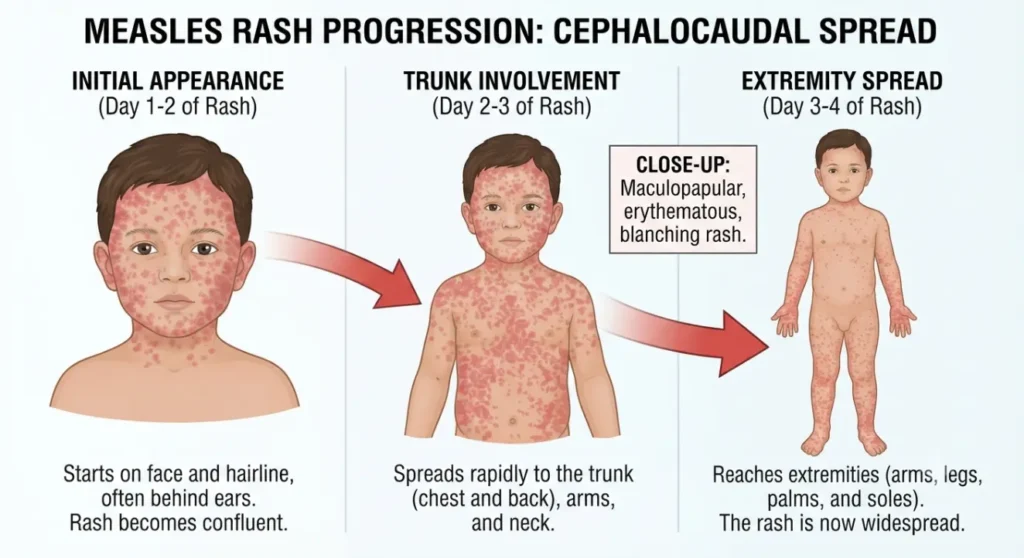
- Onset: flat red spots start along the hairline and behind the ears, then spread to the face
- Spread: over the following one to two days, the rash moves downward — to the neck and trunk, then the arms, legs, and feet
- Texture: small raised bumps often appear on top of the flat red spots, and patches may merge into larger blotches as the rash spreads
- Fever spike: body temperature may spike to over 104°F right around when the rash appears
- Fading: the rash generally fades in roughly the same order it appeared, face first, then down the body over about a week
Koplik Spots
Koplik spots are tiny white or bluish-gray dots, sometimes described as looking like grains of sand, that appear on the inside lining of the cheeks, usually a day or two before the skin rash. They’re considered one of the more distinctive early signs of measles, though not everyone develops visible spots, and they’re easy to miss without someone specifically checking the inside of the mouth.
Measles Timeline at a Glance
| Day (from exposure) | What’s happening |
|---|---|
| Day 0 | Exposure to the virus |
| Day 7–14 | Incubation period; usually no symptoms yet |
| Day ~10–14 | Fever, cough, runny nose, red eyes begin |
| Day ~12–16 | Koplik spots may appear inside the mouth |
| Day ~14–18 | Rash begins on the face/hairline, spreads downward over 1–2 days |
| Rash day 0 to +4 | Most contagious window continues (started 4 days before rash) |
| Rash day +4 onward | Generally no longer considered contagious |
| ~1 week after rash starts | Rash fades in the order it appeared |
(Timelines are typical ranges, not guarantees — individual cases vary.)
Measles in Children
Children, especially those under 5, are among the groups most likely to experience complications, including ear infections, pneumonia, and in rarer cases encephalitis. Very young infants who are too young to be vaccinated are particularly vulnerable, since they rely entirely on people around them being immune. The CDC has noted that nearly 1 to 3 out of every 1,000 children infected with measles die from respiratory or neurologic complications, a stark reminder that measles is not simply a routine childhood rash illness.
Measles in Adults
Measles isn’t just a childhood disease, and it’s frequently under-discussed for adults. Adults over 20 are among the groups more likely to experience complications from measles, alongside young children, pregnant people, and those with weakened immune systems. Adults who were vaccinated with an older, less effective killed virus vaccine used between 1963 and 1967, or who are unsure of their vaccination history, may want to confirm their immunity status with a healthcare provider, this is more common than many people realize, especially for those born in that specific window.
How Is Measles Diagnosed?
Diagnosis usually starts with a clinical exam, the combination of fever, the three C’s, and the characteristic rash pattern is often enough to raise strong suspicion, especially during a known outbreak or after a travel history. Confirmation typically involves lab testing: detecting measles specific IgM antibodies in a blood sample, or detecting the virus’s genetic material (RNA) via PCR testing from a throat or nasal swab. Urine samples can sometimes be used as well. If measles is suspected, providers are required to report it to local health departments, and lab confirmation is standard practice, so don’t be surprised if a suspected case triggers a broader public health response even before formal confirmation.
Measles Treatment
There’s no antiviral medication that cures measles. Treatment is supportive managing symptoms while the body’s immune system clears the virus. That typically includes:
- Rest and adequate fluids to prevent dehydration, especially important with high fever
- Fever reducers such as acetaminophen or ibuprofen (follow product and pediatric dosing guidance, and check with a provider for infants)
- A cool-mist humidifier or rest in a dim room if light sensitivity from conjunctivitis is uncomfortable
- Prompt medical attention if complications like difficulty breathing, persistent high fever, or confusion develop
If bacterial complications such as pneumonia or ear infections develop, those are tested for and treated appropriately, the underlying measles infection itself simply has to run its course under supportive care.
Vitamin A and Measles
Vitamin A may be given to patients with confirmed measles, but only under a healthcare provider’s supervision. This is a hospital/clinical intervention tied to specific dosing protocols in confirmed cases, not a home remedy or general supplement recommendation. This distinction matters: overuse of vitamin A can cause toxicity, damaging the liver, bones, central nervous system, and skin, and pregnant women in particular should avoid high doses of vitamin A, since it has been linked to serious birth defects. If you’re concerned about vitamin A and measles, the right move is a conversation with a healthcare provider, not self-dosing supplements at home.
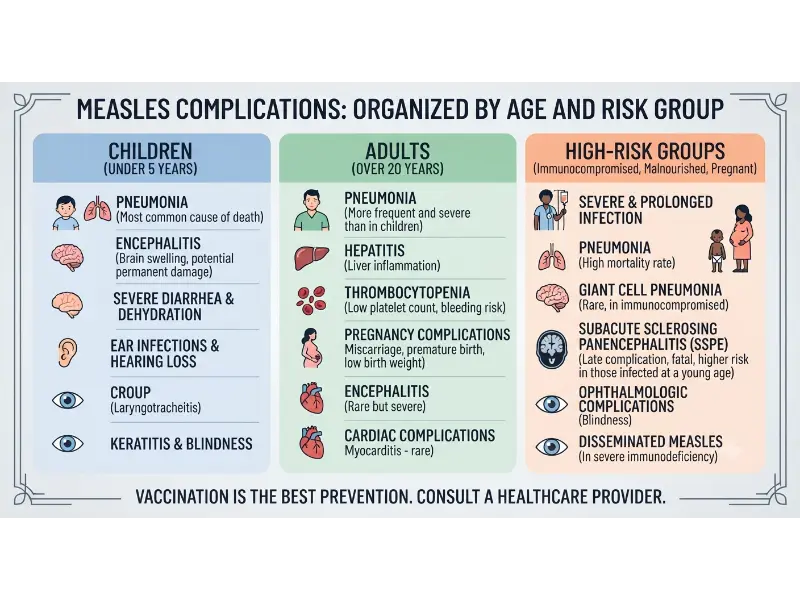
Measles Complications
Most people recover from measles without lasting harm, but complications are common enough and serious enough that measles is treated as a genuine medical concern rather than a routine illness:
- Ear infections — the most common complication, especially in children
- Diarrhea
- Pneumonia — the most common cause of measles related death in young children
- Croup (laryngotracheobronchitis), more common in young children
- Encephalitis (brain swelling) rarer, but can cause lasting neurological damage
- Subacute sclerosing panencephalitis (SSPE) — an extremely rare but fatal degenerative brain condition that can appear years after infection; the risk appears higher in people who had measles before age
- Pregnancy complications, including risk of premature birth or low birth weight
Who Is Most at Risk for Complications?
Public health data consistently points to the same higher risk groups: children under 5, adults over 20, pregnant individuals, and people who are immunocompromised (for example, due to certain cancers, HIV with low CD4 counts, or immunosuppressive treatment). Anyone in these groups who suspects measles exposure should contact a healthcare provider promptly rather than waiting to see if symptoms develop.
Measles During Pregnancy
Measles during pregnancy carries added risks, including a higher chance of premature labor, low birth weight, and pregnancy loss. Pregnant individuals who are not immune and who are exposed to measles should contact a healthcare provider right away, post-exposure options like immune globulin may be considered on a case-by-case basis. It’s also worth noting the MMR vaccine itself is a live vaccine and isn’t given during pregnancy; the standard guidance is to avoid pregnancy for about a month after vaccination and to get vaccinated before conception or after delivery if immunity status is uncertain. This is an area where individualized guidance from an OB-GYN matters more than general information,
Measles Vaccine (MMR)
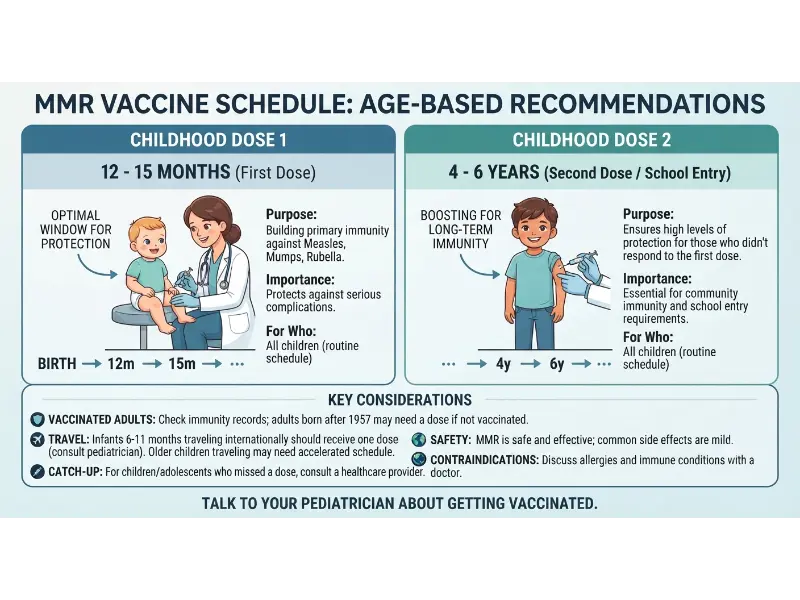
The measles, mumps, and rubella (MMR) vaccine is the primary tool for preventing measles, and it’s given as part of routine childhood immunization:
- First dose: 12–15 months of age
- Second dose: 4–6 years of age, typically before kindergarten
- Children aged 6–11 months may receive an early dose before international travel or during a local outbreak, but they still need the standard two doses on schedule afterward
Effectiveness: two doses of MMR are about 97% effective at preventing measles, and a single dose is about 93% effective. Protection from full vaccination is generally considered lifelong
Adults: if you’re unsure of your vaccination status, options include checking old immunization records, getting a titer (antibody) test, or simply getting an MMR dose, there’s no harm in receiving another dose if you may already be immune. Certain adults, healthcare workers, college students, and international travelers among them are specifically recommended to confirm two documented doses.
Can Vaccinated People Still Get Measles?
Yes, though it’s uncommon. No vaccine is 100% effective, and with two doses providing about 97% protection, a small percentage of fully vaccinated people can still be infected if exposed generally with milder illness. This is sometimes called a “breakthrough” case. It doesn’t mean the vaccine failed as a strategy; population-level protection (herd immunity) depends on the large majority of people being immune, which is exactly why coverage gaps matter so much during outbreaks.
What to Do After Measles Exposure
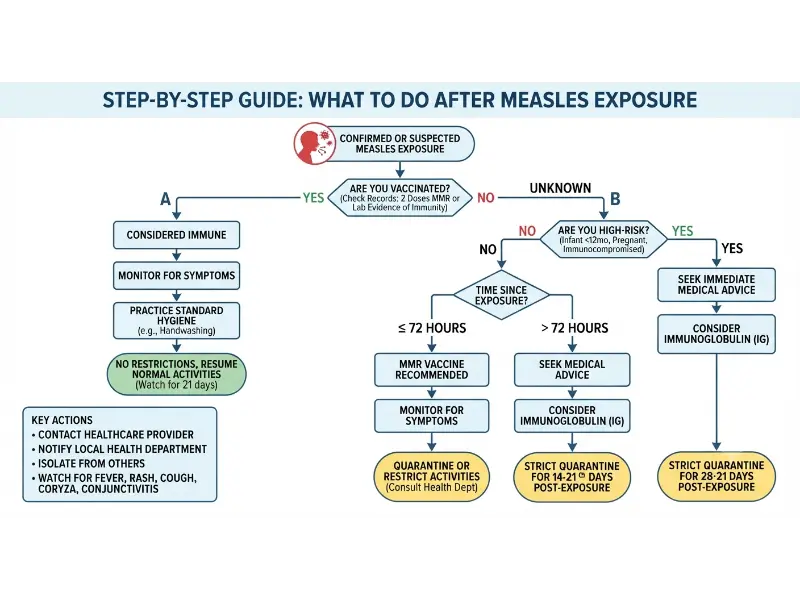
If you’ve been told you were exposed to measles, in a doctor’s office, school, airport, or elsewhere, here’s a practical sequence:
- Check your immunity status first. Documented proof of two MMR doses, prior lab confirmed measles, or birth before 1957 generally counts as evidence of immunity.
- Call before you go anywhere in person. Contact your healthcare provider or local health department by phone to describe the exposure walking into a waiting room can expose others.
- Watch the calendar, not just how you feel. Symptoms can take 7–14 days (occasionally longer) to appear, so a single day without symptoms doesn’t clear you.
- Ask about post-exposure options. Depending on timing and your risk profile, a provider may discuss MMR vaccination or immune globulin given shortly after exposure.
- Follow isolation guidance if you’re not immune. Local health departments may recommend quarantine for a set window and ask you to avoid high risk settings like childcare facilities or hospitals.
- Monitor for symptoms and isolate promptly if they start, especially fever combined with cough, red eyes, or a runny nose.
When to Seek Medical Care
Call a healthcare provider promptly ideally by phone before an in person visit if you or your child:
- Have a fever along with cough, red eyes, and a runny nose, especially after a known exposure or during a local outbreak
- Develop a spreading rash consistent with the pattern described above
- Have difficulty breathing, a high fever that won’t come down, unusual drowsiness, confusion, or a stiff neck
- Are pregnant, an infant, or immunocompromised and think you may have been exposed
Measles vs. Rubella vs. Chickenpox
These three rash illnesses are commonly confused. Here’s a side-by-side comparison:
| Feature | Measles | Rubella | Chickenpox |
|---|---|---|---|
| Cause | Measles virus | Rubella virus | Varicella-zoster virus |
| Contagiousness | Extremely high | Moderate | High |
| Prodrome | High fever, cough, red eyes, runny nose | Mild or no fever, swollen lymph nodes | Mild fever, fatigue |
| Rash appearance | Flat red spots, often merging, spreads face → down | Fine, pink, less merged rash, spreads face → down, fades faster | Itchy fluid-filled blisters in crops, appear all over at once |
| Distinctive sign | Koplik spots inside mouth | Swollen lymph nodes behind ears/neck | Blisters at multiple healing stages simultaneously |
| Typical severity | Can be severe, notable complication risk | Usually mild (main risk is to a fetus if pregnant person infected) | Usually mild in healthy children, riskier in adults |
| Vaccine | MMR | MMR | Varicella vaccine (or MMRV combo) |
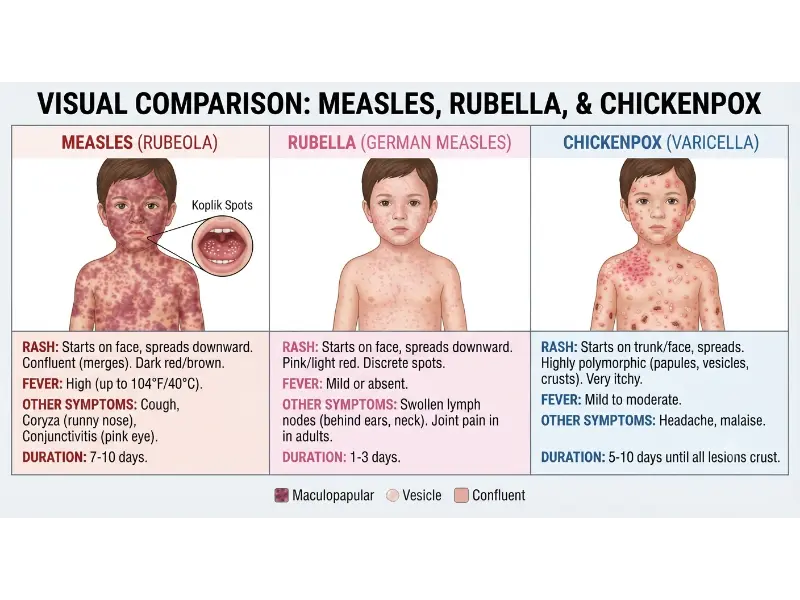
The clearest practical distinguishers: measles’ Koplik spots and merged, spreading rash; rubella’s milder course with prominent swollen lymph nodes; and chickenpox’s itchy blisters appearing in waves at different healing stages rather than a single spreading pattern.
Frequently Asked Questions
Is measles fatal?
It can be, though most people recover. Complications like pneumonia and encephalitis cause the majority of measles deaths, and children under 5 face the highest risk.
How long after exposure am I contagious if I get sick?
Symptoms usually take 7–14 days to appear, and contagiousness starts about 4 days before the rash shows up — which is often before you’d even suspect measles.
Can adults get measles even if they had it as a kid?
Natural infection generally provides lifelong immunity, so a confirmed prior case protects you. Uncertainty usually comes from not knowing your history, not from immunity fading.
Is the MMR vaccine safe?
Major health authorities, including the CDC, consider MMR vaccine safety well established through decades of monitoring, and it does not cause autism — a claim that’s been extensively studied and not supported by evidence.
Does vitamin A prevent or cure measles?
No. It’s sometimes used as a supportive treatment in confirmed cases under medical supervision, not as prevention, and high doses without medical guidance can be harmful.
What should I do if my child was exposed at school?
Contact your pediatrician or local health department, confirm your child’s vaccination status, and watch for symptoms over the following two to three weeks.
Sources
- Centers for Disease Control and Prevention (CDC) — Signs and Symptoms, Clinical Overview, Vaccine Recommendations, and Cases and Outbreaks pages, cdc.gov/measles
- American Academy of Pediatrics, Red Book Online — Measles Outbreak Data
- https://www.cdc.gov/measles/data-research/index.html
- World Health Organization (WHO) — Measles fact sheet, who.int
Dr. Shahzad Khurram is a dedicated Pediatrician and medical researcher passionate about empowering parents with evidence-based health insights. With a clinical focus on childhood nutrition and neurodevelopment, Dr. Khurram translates latest clinical data into actionable advice for modern families. Through Medifitverse, he bridges the gap between pediatric science and everyday parenting, ensuring every child has the nutritional foundation they need to thrive. His work is guided by the latest standards from the American Academy of Pediatrics and current nutritional research.
Medical Disclaimer: The information on Medifitverse, including text, graphics, and images, is for educational and informational purposes only. This content is not intended to be a substitute for professional medical advice, diagnosis, or treatment. Always seek the advice of your pediatrician or other qualified health provider with any questions you may have regarding a medical condition. Never disregard professional medical advice or delay in seeking it because of something you have read on this website.However, every baby is different. Consult your doctor before introducing allergens or changing your infant’s diet.
NOTE: Check my folic acid for kids blog which helps autistic kids.
Contact Dr. Shahzad Khurram here, or click whatsapp icon for direct chat.